Idealized Art Depicts Certain Features as Nonorganic Surface Elements Rather Than Realistically

Caravaggio, The Doubting of Thomas, c. 1601-02, oil on canvas, 107 x 146 cm (Sanssouci Picture Gallery)
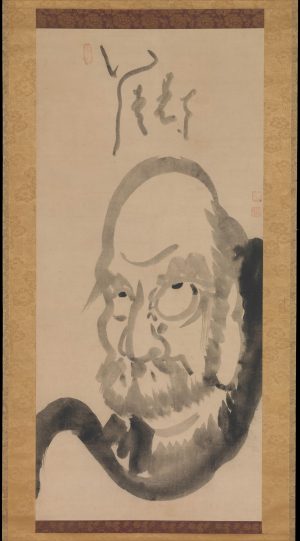
Hakuin Ekaku, Portrait of Daruma, mid-18th century, Edo period Japan, hanging ringlet, ink on newspaper, 117.5 x 54 cm (The Metropolitan Museum of Art)
Naturalism is resemblance to the "existent globe," as we see it effectually united states of america. The more naturalistic a work, the more information technology looks like our world, and the less naturalistic, the less then.
Representational versus non-representation
For extremes, we volition compare a work by Caravaggio with a work by Hakuin Ekaku, a Japanese Zen Buddhist monk. Caravaggio's Italian Baroque The Doubting of Thomas is highly naturalistic, whereas Hakuin'due south portrait of Daruma rejects naturalism. Both paintings are representational, which means that they both describe something, equally opposed to non-representational works similar Pollock's Autumn Rhythm (Number xxx), where there is no visual picture hidden in the lines.
Verism
In Caravaggio's epitome, the face of Thomas, who leans downward to expect straight at the wound in Jesus' side, is rendered in minute, realistic detail. His hairs are individually rendered, his features distinct and recognizable, his pare browned from the sun and with dirt.
Caravaggio plant his models for holy figures in the streets, and their humble weather are carefully depicted in his paintings. All this adds upwards to naturalism, and possibly even to the highest degree of naturalism, referred to as verism.
Moving toward brainchild
Ekaku'southward portrait of Daruma, on the other manus, is recognizable as a human face up, just all the elements take all been rendered somewhat abstractly — that is, in some style deviating from or ignoring the natural world, simplifying or altering it for effect. Nosotros might likewise say that Ekaku's image is stylized — designed according to the principles of a particular style rather than being appreciative to the way things look in "the real world."
This does not make information technology less "adept" as a work of art, and also does not mean that the artist was less skilled. Rather, it is simply a unlike, less naturalistic fashion, designed to suit dissimilar goals. Here, the emphasis is not on the great Buddhist sage's literal advent (he died over a millennium before this work was made), but on his wisdom, embodied in his giant, upturned optics and vast forehead.
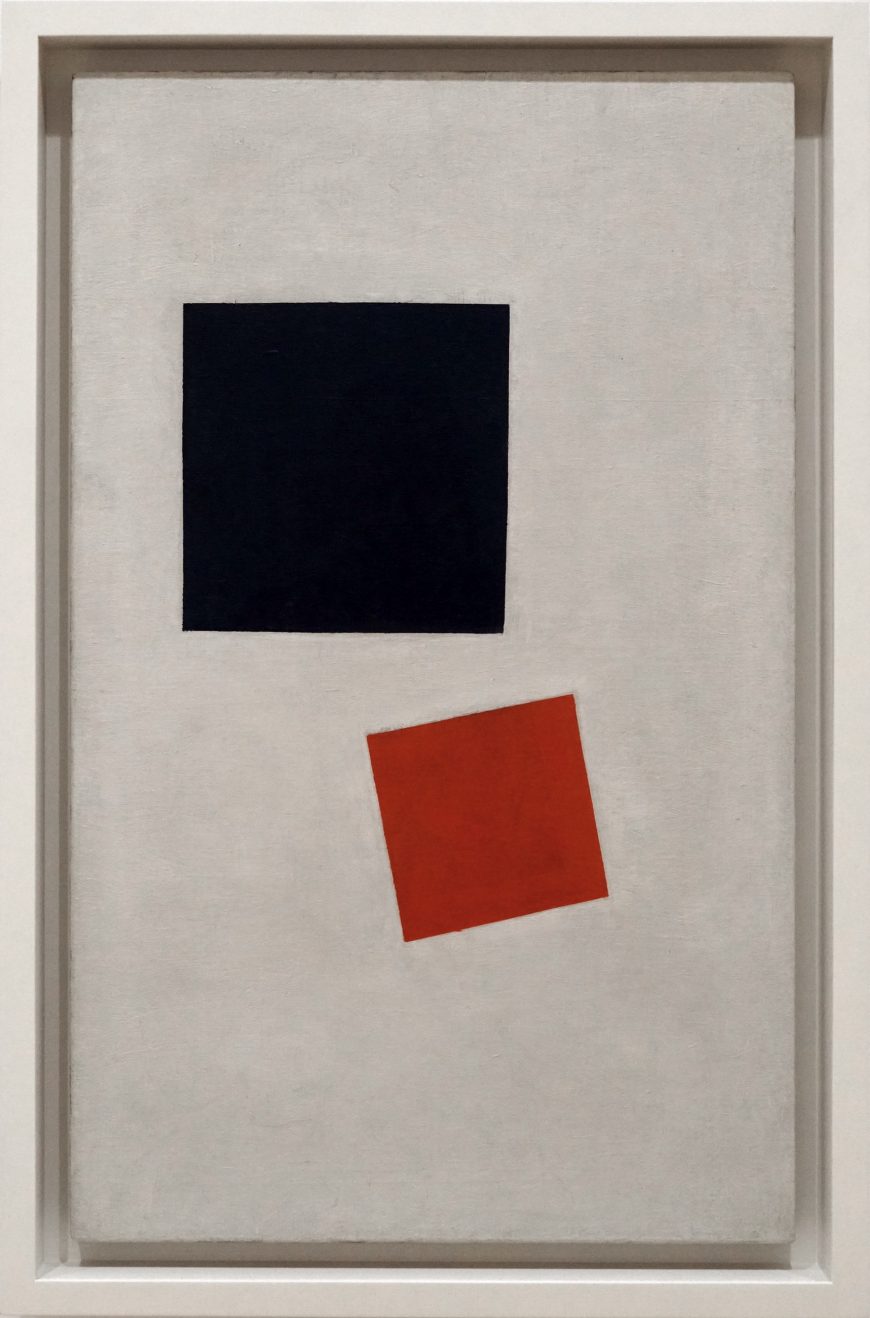
Kazmir Malevich, Painterly Realism of a Boy with a Knapsack – Color Masses in the Quaternary Dimension, 1915, oil on canvas, 71.1 x 44.v cm (The Museum of Modern Fine art)
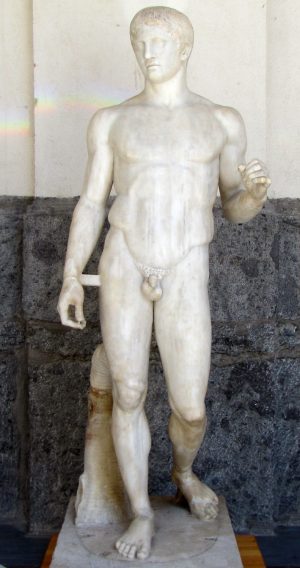
Polykleitos, Doryphoros, c. 450-twoscore B.C.East., ancient Roman marble copy of a lost bronze original, 211 cm (Archaeological Museum, Naples)
Non-representational art
The farthest extent of abstraction is non-representational or not-objective art, in which the subject is not merely abstract, merely wholly absent.
This type of art, which many viewers find highly challenging, makes trivial or no reference to the natural world, such every bit Kazimir Malevich's geometric paintings such as Painterly Realism of a Boy with a Knapsack – Color Masses in the Time.
In such works, nosotros are in a purely formal world, with no recognizable subject field in the work but the piece of work, itself, and where the tools of visual assay are the only points of entry into the piece of work.
Idealization
There is i other way, though, that nosotros tin can speak of naturalism. Instead of contrasting it with abstraction, nosotros can contrast it with realism.
We can see that the Doryphoros is highly naturalistic, in that he looks very much similar a living person. On the other hand, he presents his culture's physical ideal of symmetry, youth, fitness, and, indeed, relaxation.
If we are being honest, nosotros would accept to admit that while a person could look like this, rather few of us do. It is therefore highly idealized. In this sense, the work lacks realism — since, in a way, according to ancient Greek views, it is too perfect.
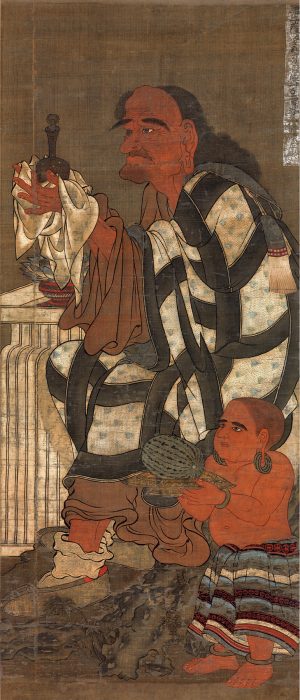
Satsubari, The Second of the Sixteen Rakan, belatedly 14th century, hanging curlicue; ink, colour, and gold on silk, 115.iii x 49.3cm (Mary Griggs Burke collection)
Naturalism and realism
Let'southward take another example — a fourteenth century Japanese painting, The Second of the Xvi Rakan (Rakan are figures in Buddhism who protect Buddhist law and anoint donors). Here the figure does non announced naturalistic, in that the work is clearly a painting, with a loose style and exaggeration of features.
On the other manus, the work is highly realistic, in that the creative person has presented u.s.a. with a figure that is ordinary or fifty-fifty slightly grotesque, rather than idealized. He is old, wrinkled and bent, his earlobe hanging low (stretched out by big gilded earrings) equally a marking of his by wealth. His clothes are rumpled, his socks slipping down. While the prototype is not very naturalistic, it is still highly realistic.
Naturalism, realism, abstraction and idealization
Disentangling naturalism from realism is tricky, and the terms are sometimes used interchangeably, despite their important differences.
Naturalism and realism might or might non announced in the same work. An image might be naturalistic and realistic, similar The Doubting of Thomas, or naturalistic and idealized, as is Doryphoros.
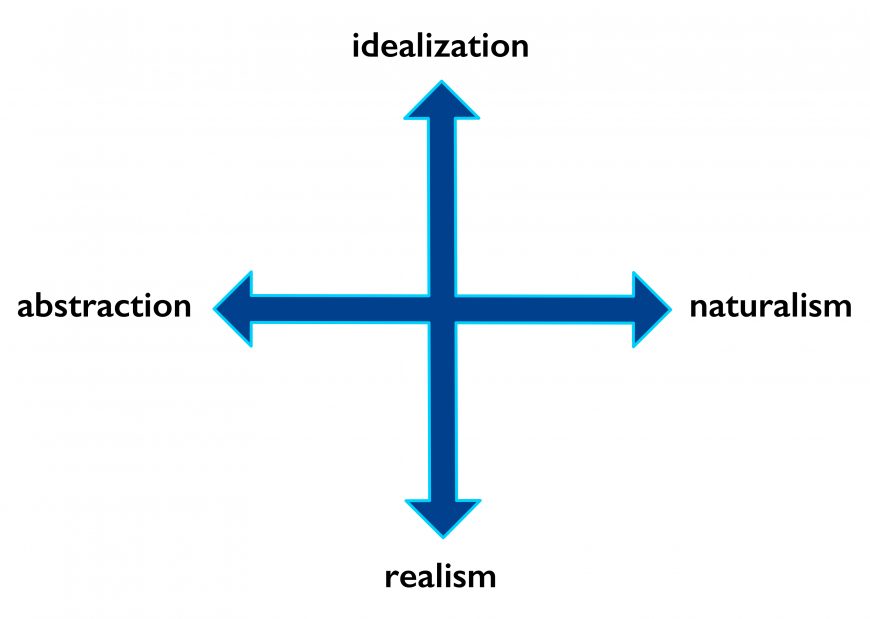
Alternately, a work might be abstracted and realistic, like the Second Rakan, or abstracted and idealized, like St. John in the Lindisfarne Gospels). A diagram presents the nexus of these terms, and we might plot just about every piece of work of art in this book somewhere within it .
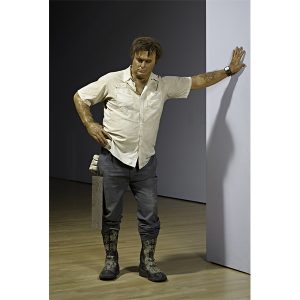
Duane Hanson, Slab Human. 1974-75, vinyl resin and fiberglass, polychromed in oil (Cantor Arts Center)
Also real?
Some works, of class, like those past Duane Hanson, have both forms of naturalism.
His life-size sculptures of people revel in their ordinary nature, and are also startlingly lifelike — veristic — so much so that they are frequently mistaken for real people when on display in museum exhibitions.
I accept been fooled by two of them, over the years. One was dressed as a museum guard and some other equally a workman. Even though I had seen Slab Human being dozens of times, when his gallery was nether construction and he was surrounded by carts of equipment and tools, I was fooled anew.
Cite this page every bit: Dr. Asa Simon Mittman, "Naturalism, realism, abstraction and idealization," in Smarthistory, July 11, 2019, accessed Apr 25, 2022, https://smarthistory.org/naturalism/.
Source: https://smarthistory.org/naturalism/
0 Response to "Idealized Art Depicts Certain Features as Nonorganic Surface Elements Rather Than Realistically"
Post a Comment